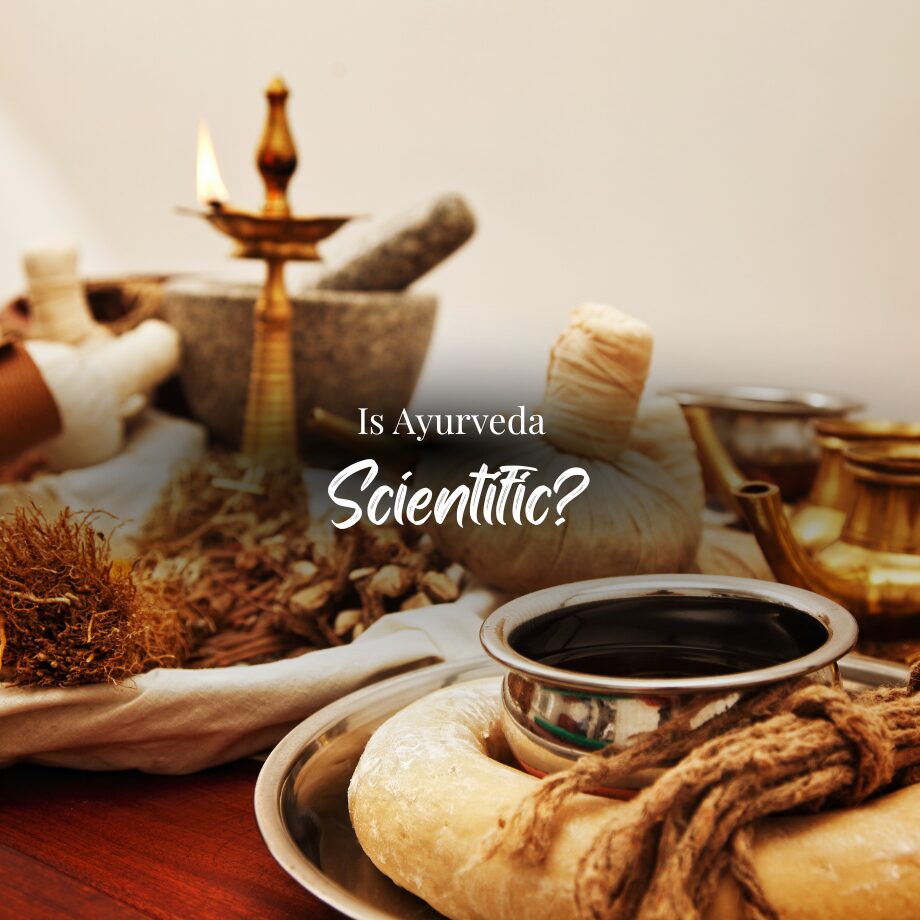
Ayurveda is a medical system that dates back more than 5000 years. This ancient medical system stands on some important pillars. These pillars are the core concepts or principles that explain Ayurveda.
“Ayurveda” comes from “Ayur”, or life, and “Veda,” meaning knowledge. It means the knowledge of living well. But where did it all start? It all started with the ancient sages. They observed nature, the human body, seasons, food, and the mind. Also, some of them refined this knowledge through experience and passed the wisdom to students.
Later, this knowledge found expression in the Vedas. (Known as the oldest spiritual Indian texts.) Classical Ayurveda associates with Lord Dhanvantari, the divine physician and an incarnation of Lord Vishnu. Today, people know him as the God of Ayurveda because he gifted this science to humankind.
Moving forward, great scholars gave Ayurveda a much-needed clearer structure. Charaka and Sushruta were two such renowned scholars at the time. Charaka compiled and organised internal medicine. His intent was to explain the cause of diseases and their Ayurvedic treatment. Sushruta systematised surgery and anatomy with logic. Because of this strong laid foundation, Ayurveda became the “Mother of all healing systems.”
But What Makes Ayurveda Different?
Ayurveda is different from other medical sciences. It emphasises the whole body rather than focusing on just one part. Why? Ayurveda studies the human body in a holistic manner. Let’s understand it through a simple example.
Let’s say you have frequent headaches. Modern medical treatment and Ayurvedic treatment will be different. Doctors will focus on the head and prescribe painkillers. At the same time, an Ayurveda physician will go deeper. How? He will ask many related questions, like How is your digestion? How is your sleep? Are you stressed? What do you eat?
Asking such questions helps the Ayurvedic doctor to find the root cause of the headache. Also, treat the cause of the headache, not the symptom. Ayurveda blames the imbalance in the doshas for causing health issues. So, Ayurvedic doctors aim to balance the tridoshas.
This is why Ayurveda has important pillars such as diet, lifestyle, and dinacharya (daily routine) together. Experienced Ayurvedic doctors from Vaidyaratnam Vrindavan Ayurveda Chikitsalayam, Dr. V.M Gopal Menon quotes Ayurvedic principles as –
“In my 25 years of practice, the principles of Ayurveda are about the correction of imbalanced Ayurvedic doshas.”
Why is Balance Important?
According to Ayurveda, the human body is a living ecosystem in which every function connects with the others. Everything from diet to emotions affects our internal system. So, Ayurveda believes in the prevention of disease. It teaches us to correct our daily routines, seasonal habits, and lifestyle. All of this makes “healing” a natural outcome.
Dr. Menon, who has been practising Ayurveda for more than 25 years, considers the five elements of nature to be Ayurvedic principles. Let us elaborate on each one of them in detail.
What are the Basic Principles of Ayurveda?
“Life” works on some laws of nature. Because there is a connection between the human body, the microcosm, the macrocosm, and the entire universe. And no, it has no spiritual basis. The simple idea in Ayurveda is, “What happens inside our body will reflect outside.” It also applies otherwise.
Now, this connection works through the “Five Elements of Nature”: air, water, space, fire, and earth. Let us know them in detail.
What are the Five Elements or Pancha Bhutas?
Charak Samhita describes the Panchamahabhutas and their properties using a shloka. It is:
महाभूतानि खं वायुरग्निरापः क्षितिस्तथा।
शब्दः स्पर्शश्च रूपं च रसो गन्धश्च तद्गुणाः॥
Transliteration: Mahābhūtāni khaṁ vāyur agnir āpaḥ kṣitis tathā
Śabdaḥ sparśaś ca rūpaṁ ca raso gandhaś ca tad-guṇāḥ ||
This shloka in Charak Samhita explains the five elements of nature that form the human body. Ayurveda calls them Panchamahabhutas. It says that these elements cannot function in isolation. They are present in every living and non-living thing.

- Akasha (Space/Ether): Space gives everything to expand and exist. If we speak about its quality, it is sound.
- Vayu (Air): It creates flow and movement in the body. Qualities are sound and touch.
- Agni (Fire): Fire brings change, heat, and transformation. One example is digestive fire in the body. Its qualities are sound, touch, and form.
- Jala (Water): In the form of blood, water, bodily fluids, and other fluids. They keep things together and keep them flowing. Qualities of Jala are sound, touch, form, and taste.
- Prithvi (Earth): This element provides shape, strength, and structure to the body. It includes all the qualities of touch, form, sound, taste, and smell.
These elements don’t operate on a superficial level. They are present in everything in different proportions. From the human body to food to emotions. When these elements stay in balance, a person remains healthy. On the other hand, when one element is out of balance, the body invites disease.
What Are Ayurveda Doshas?
Ayurveda doshas, or the Tridosha theory, combine three functional forces that control every physical and mental activity. So, how do these three types of doshas act in the body? Let’s find out.
- Vata (Space + Air): Vata dosha controls movement in the body. It manages breathing, nerve signals, blood circulation, speech, and creativity. When Vata is out of balance, a person experiences anxiety, restlessness, mood swings, digestive issues, insomnia, and others. In Ayurveda, Vata dosha has the following properties:
- Light (Laghu)
- Dry (Raghu)
- Cold (Sheeta)
- Clear (Vishada)
- Rough
- Mobility (Chala)
- Kapha Dosha (Water + Earth): This Ayurveda dosha offers stability. It governs immunity, lubrication, emotional calmness, and more. Unlike Vata dosha, Kapha is:
- Heavy (Guru)
- Slow (Manda)
- Cool (Sheeta)
- Oily (Snigdha)
- Smooth (Sulakshana)
- Stable (Sthira)
- Dense (Sandra)
When Kapha dosha is in excess, the body experiences weight gain, sluggishness, congestion, slower metabolism, lack of motivation, and more.
- Pitta (Fire + Water): The Pitta dosha manages transformation. It means that it controls digestion, metabolism, hormones, intelligence, and body temperature. Also, it governs a person’s vision, skin health, and emotional balance. Pitta dosha has the following qualities:
- Hot (Ushna), Sharp (Tikshna), Oily (Snigdha), Light (Laghu), Intense (Sara), and Liquid (Drava).

Note: Every individual has all three types of doshas. But the proportion of each dosha varies. Ayurveda calls this “Prakriti.”
When Ayurveda doshas stay in balance, a person feels energetic, calm, and strong. Whenever this balance breaks, Ayurveda calls it Vikruti. Vikruti is where the disease starts.
What are the Three Fundamental Texts of Ayurveda?
Ayurveda dates back over 5000 years and originated in India. Ayurvedic wisdom was first passed down from teacher to student. Later, several sages compiled this knowledge in writing and gave it structure. Finally, these texts have given the world core principles of Ayurveda to follow and practice.
The three core classical texts are known as the “Brihattrayi” or the Great Trilogy of Ayurveda. These are the three fundamental texts of Ayurveda that shape how people study, understand, and practice even today. These texts are:
1) Charaka Samhita: This text focuses on internal medicine. It explains how diseases develop, how to examine patients, and how to choose the right treatment.
2) Sushruta Samhita: Written by Sushruta, it describes more than 120 surgical tools and detailed surgical procedures. It includes wound care, bone setting, and cosmetic surgery, too.
3) Vagbhata Samhita: This classical fundamental text combines both traditions. It means that it simplifies the teachings of Charaka and Sushruta.
The Eight Branches of Ayurveda (Ashtanga Ayurveda)
Among many important Ayurveda principles, specialised branches focus on different areas. They are as follows:
| Ayurvedic Name | What does it mean? | Main Area of Focus |
| Kāya Chikitsā | Internal Medicine | Digestion, metabolism, fever, diabetes, skin disorders, and chronic diseases |
| Śalya Tantra | Surgery | Surgical procedures, wounds, fractures, tumors, abscesses, trauma, and cosmetic surgery. |
| Śālākya Tantra | ENT & Eye Care | Diseases of the eyes, ears, nose, throat, head, and oral cavity. |
| Kaumāra-bhṛtya | Pediatrics & Obstetrics | Pregnancy care, childbirth, newborn care, child growth, and the immunity of the newborn |
| Bhūta Vidyā | Psychiatry & Mental Health | Mental disorders, emotional problems, anxiety, fear, behavioral issues, and more. |
| Agada Tantra | Toxiocology | In case of poisoning, snake bites, insect bites, food and drug toxicity. |
| Rasāyana Tantra | Rejuvenation & Geriatrics | Longevity, immunity, anti-aging, strength, and memory enhancements. |
| Vājīkaraṇa Tantra | Reproductive & Sexual Health | Fertility, sexual wellness, reproductive disorders, and hormonal balance. |
These 8 branches of Ayurveda cover every stage of life. From birth to old age, each stage sets physical, mental, and emotional characteristics. All these Ayurvedic principles make it no less than a scientific medical system.
Now the main question arises. How are diseases diagnosed according to Ayurveda? Ayurvedic doctors study the person as a whole. To support this, Dr. Menon shared:
“It is important to observe the body, mind, habits, and diet of a patient to diagnose the problem. I personally never skip asking about their emotional state. Because that counts too.”
He also elaborated and gave four Ayurvedic methods. They are:
- Pratyaksha: What doctors can see, feel, and hear directly
- Anumana: Gathering information from signs and symptoms of the diseases
- Aptopadesha: Following and referring to the knowledge from classical texts
- Yukti: Practical reasoning that connects all the findings and comes to a conclusion
Ayurveda places great importance on Agni. Agni is the digestive fire and governs many functions of the body. When Agni is weak, digestion becomes slower. And a slower digestive process leads to the accumulation of toxins in the body, called Amas. These sticky amas lead to inflammation and disease. Today, even science claims that chronic inflammation causes disease.
What are the 5 Treatments of Panchakarma?
Panchakarma treatment is also part of the core principles of Ayurveda. As you know, Ayurveda never suppresses the symptoms. Classical Panchakarma removes toxins from the body using five purification therapies. They are:
- Nasya: This Ayurvedic treatment cleanses the head with herbal oils delivered through the nose.
- Vamana: It removes excess mucus through controlled and observed vomiting.
- Virechana: It clears toxins from the liver and gut.
- Basti: Ayurvedic doctors give medicated enemas to balance the Vata dosha and nourish the tissues.
- Raktamokshana: Medicated leeches purify the blood in the affected areas.
Is Ayurveda Scientific?
Many people still question Ayurveda as a scientific medical science. But modern research is now opening the door to new claims. Scientists today study Ayurveda through fields like Ayurgenomics and epigenetics.
Yes, several principles of Ayurveda make its foundation trustworthy. Researchers now test Ayurvdic treatments using scientific methodology, which is a step forward in calling it no less than a science.
For instance, Studies on Arjuna powder and Arogyavardhini Vati show a reduction in cholesterol and triglyceride levels in people with lipid disorders. Also, several human trials on Chyawanprash showed improved immunity, increased energy, and overall well-being.
Interestingly, researchers are finding links between Prakriti types and specific genes. For example, variations in the PGM1 gene show association with Pitta dosha constitution. Epigenetic studies reveal how factors such as diet, lifestyle, stress, and environment can switch genes on and off.
How Modern Science Supports Ayurvedic Herbs
Lab studies explain the benefits of Ayurvedic herbs that ancient sages already knew.
- Turmeric (Curcumin): This herb has anti-inflammatory and anti-cancerous properties. Also, it reduces harmful inflammatory chemicals in the body.
- Ashwagandha: Research studies show it boosts antioxidant enzymes and protects cells from external stress and damage.
So, integrating Ayurvedic principles and modern medical science can be the future of wellness. Doctors worldwide support integrative medicine. Combining modern diagnostics with Ayurvedic lifestyle care will treat and prevent chronic diseases, stress disorders, and long-term wellness.
Dr. Menon approves and spreads the integrative approach to treat all health seekers. He also adds:
“Always consult a trained Ayurvedic doctor before getting any treatment. Neither Ayurveda nor science disapproves of the other. They are the future.”